
Are virtual labs better than physical labs? (Not in the way you think)
Virtual labs are often compared directly to physical labs, as though the goal would be to recreate the same experience as closely as possible in an online format.
In reality, they’re not directly comparable. Physical labs offer something that cannot be fully replicated: real equipment, physical presence, and tactile experience. However, as has become increasingly evident in recent years, they are also constrained by space, time, staffing, access, and cost. Not every student gets the same level of participation in a physical lab either, with equipment often needing to be shared for experiments.
Virtual labs are designed to alleviate many of these limitations, though many introduce different challenges. Most virtual or online learning offerings have students completing activities alone, often as homework assignments, working through step-by-step instructions with limited interaction or support.
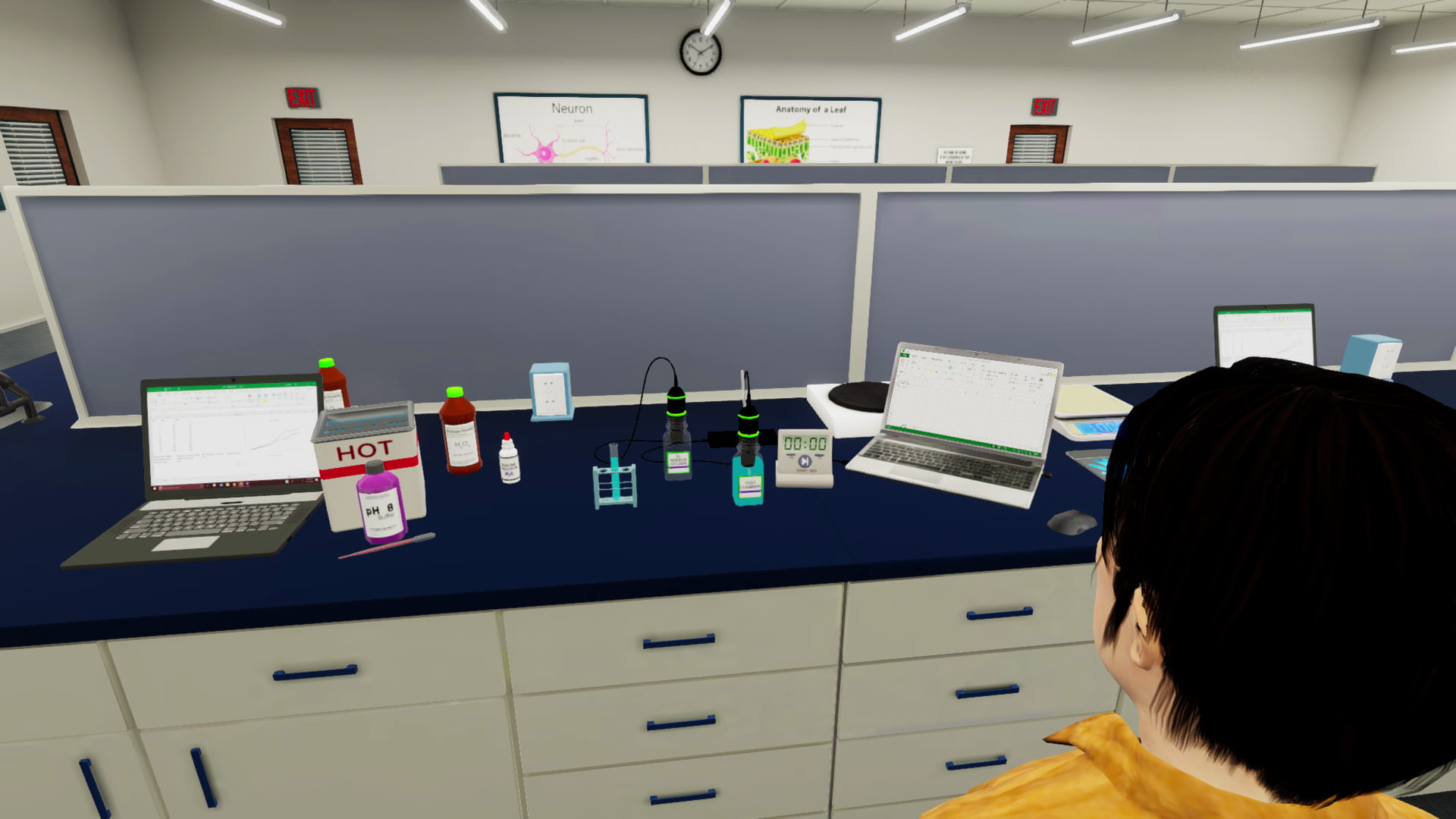
View of a student’s lab bench in UniVirtual
Where do virtual labs fall short?
A common format for online labs looks like this: students read through instructions to learn the material, they drag and drop elements, and they follow predefined steps to reach an outcome. This may sometimes be referred to as an “interactive textbook,” where content is explored in individual pieces, perhaps via 3D assets or videos that go into greater detail about a topic.
While these approaches can be useful for introducing concepts, they’re not really learning “environments”, nor can they recreate the social aspect of a classroom. The experience is structured and reliable, but it’s not necessarily engaging. This is reinforced by the fact that these labs are typically delivered as homework assignments, with students working without access to their instructors or peers and left with only AI characters or on-screen hints to guide them.
In contrast, effective learning, particularly in lab-based subjects, often depends on social interaction and dialogue, which is lost in most virtual lab offerings.
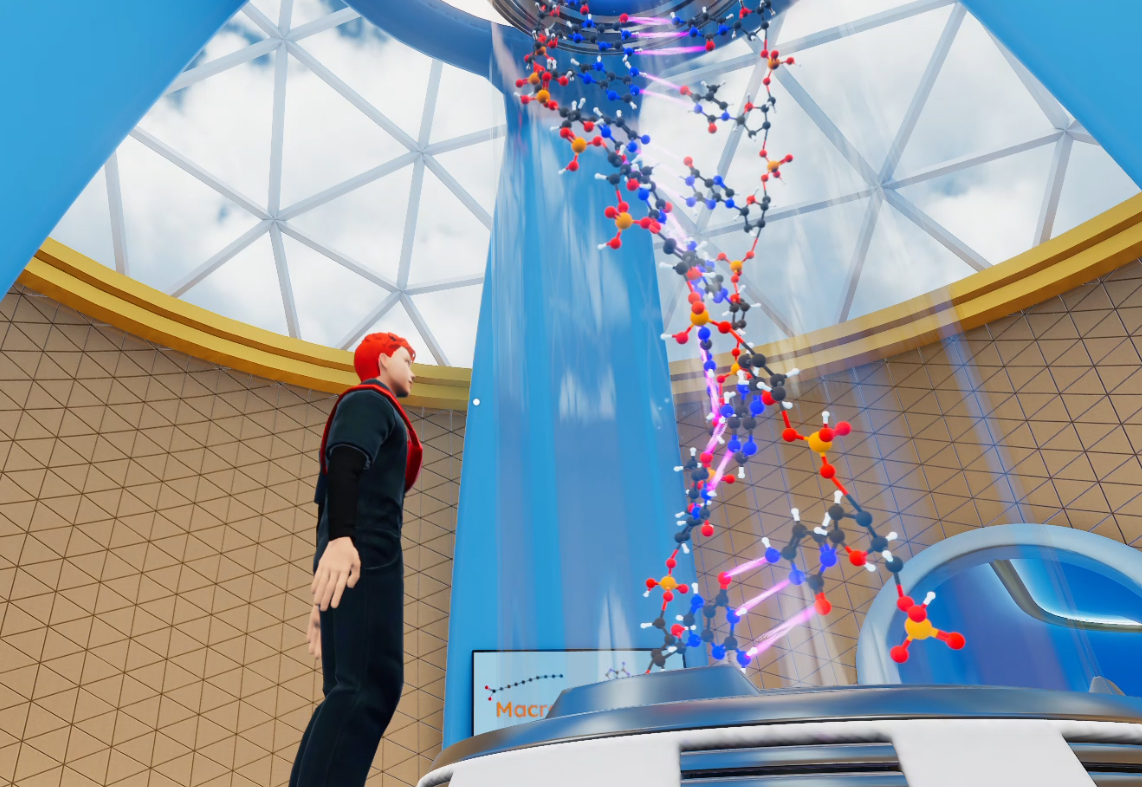
A student waits for class to start in UniVirtual’s Macromolecules museum
What makes a virtual lab effective?
The effectiveness of a virtual lab is not determined by how closely it mimics a physical one, but by how effectively it supports active, supported, and shared learning.
Three elements are particularly important: collaboration, interactivity, and context.
1. Social, collaborative learning
On the UniVirtual platform, students are not working in isolation. Sessions are scheduled within class time, with teaching assistants and instructors present, allowing students to ask questions, observe others, and receive guidance in real time.
Students can see each other in the environment, communicate by voice or text, and choose to work together. Teaching staff can monitor progress, step in when needed, and guide students in the same way they would in a physical lab. This is particularly valuable in large classes, where it is often difficult for instructors and teaching assistants to provide individual support in a physical setting.
As one lab coordinator described:
“In an environment where the instructor is logged in and those students can work together, those ‘aha’ moments are still present. You can lead them towards that moment the way you would in a classroom.”
This shared environment creates opportunities for social and peer learning that are often missing from traditional online formats.
2. Structured interactivity (beyond click-and-drag)
Interactivity alone is not enough to make a virtual lab engaging. The way students interact matters, too.
Rather than following a fixed sequence of actions, students should not only be working towards clear objectives, they should be making decisions and applying what they have learned as they go. Progression should be driven by understanding rather than task completion.
In practice, this means working through tasks that build on each other, testing ideas and refining them, and receiving feedback, not just instruction. The result is a more active form of learning, where students are participants rather than observers.
3. Storytelling and immersion
Context plays a significant role in engagement. When tasks are framed within a broader scenario, students are more likely to engage with the material and retain what they learn.
In our virtual Mendelian Genetics labs, students work within a narrative designed to reinforce concepts and improve retention. The lab covers core topics such as Punnett squares, monohybrid and dihybrid crosses, genotype and phenotype, and pedigree analysis.
They begin by analyzing plant samples with their peers in a desert greenhouse, determining whether they are true-breeding and identifying their genotypes through monohybrid crosses. As they progress, they uncover clues left by a missing researcher, leading them to a hidden area that can only be accessed by producing a specific genetic combination through a dihybrid cross.
From there, the task expands into an experience. Students must investigate an alien species that has crash-landed nearby that is affected by a genetic condition. They complete a corrupted pedigree and use their understanding of inheritance patterns to identify and administer the correct treatments to effectively save the aliens.
Throughout the session, students are applying concepts alongside their peers, asking questions and comparing approaches, and seeing the consequences of their decisions. The moment of understanding is tied to action and application.
The key difference here is not content or learning objectives but how that content is experienced.
So, are virtual labs better than physical labs?
Physical labs remain as essential as instructor presence in learning, of course. They provide experiences that cannot be replaced, particularly when it comes to handling real equipment and developing practical skills. However, with institutions facing increasing class sizes and constrained resources, a shift in approach is becoming less of an option and more of a necessity.
While virtual labs are not designed to replicate those experiences directly, they offer different advantages if designed effectively, such as the ability to scale to large numbers of students, the opportunity for every student to participate fully in experiments, and the flexibility to repeat and explore concepts in more depth.
Rather than positioning physical and virtual labs in opposition, it is more useful to consider how each contributes to effective learning.
The most effective virtual labs combine collaboration, structured interactivity, and meaningful context, enabling students to actively participate, engage with peers and instructors, and build a deeper understanding of complex concepts.
Want to see it for yourself? Try our free UniVirtual biology demo.